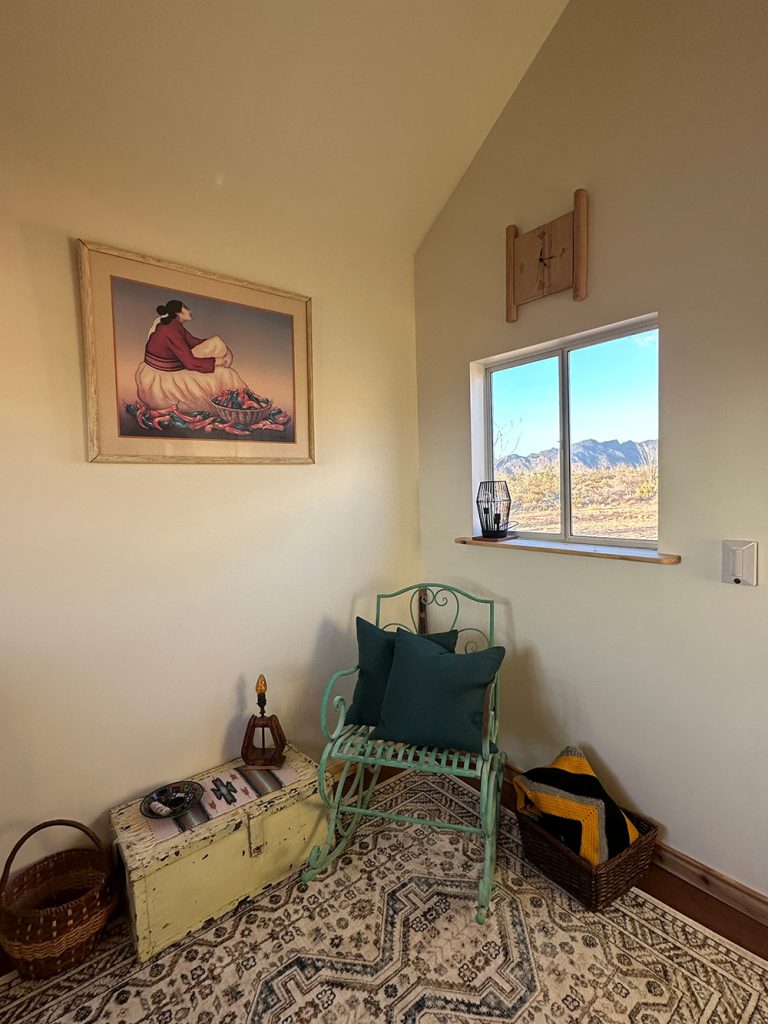
We recently finished an old structure into an office space. The structure was originally built several years ago and was going to be used as a tiny home. The space is a single room measuring around 10′ x 12′. There is also a loft which covers about a third of the overall space. We knew we were not going to use the structure as a dwelling, but it made perfect sense as an office since we run our business from home.
As we worked to furnish and decorate the space, we had a few preferences for the pieces we would use and display. It is a small space after all.
- We wanted the space to feel warm and “homie.” Working from home involves long hours working on the computer so we wanted nice lighting, smells, and colors.
- We wanted a Southwestern Americana theme. When you look out the windows of our office, you can see miles and miles of gorgeous Arizona desert. We wanted our interior to compliment the natural views.
- We wanted quality furniture. Running a business involves lots of phone calls and Zoom meetings. Therefore, we wanted furniture that reflects business professionalism, is comfortable, and will last a long time.
- Lastly, we wanted art and decor to be antique or unique. We like pieces of art that have a story. Sometimes the story is that of the artist, other times the story is of how we acquired the item. Either way, we wanted all of the pieces to be conversation starters.
Finally in addition to the above points, we also knew that we wanted to thrift as much of the furniture and decor as possible. Thrifting, rather than buying new, is an important part of our sustainable living values. It also makes everything so much more affordable. So, without further ado, here is the story of the largest piece of art, currently on our wall.
Finding R.C. Gorman Art
We found the piece at one of our favorite thrift stores in Lake Havasu City, Veterans Thrift. We go to this thrift store so often that we tend to have a routine—we start inside and one of the last stops we make is outside in the yard. They usually have some interesting outdoor furniture and often there is a table for items marked 75% off.
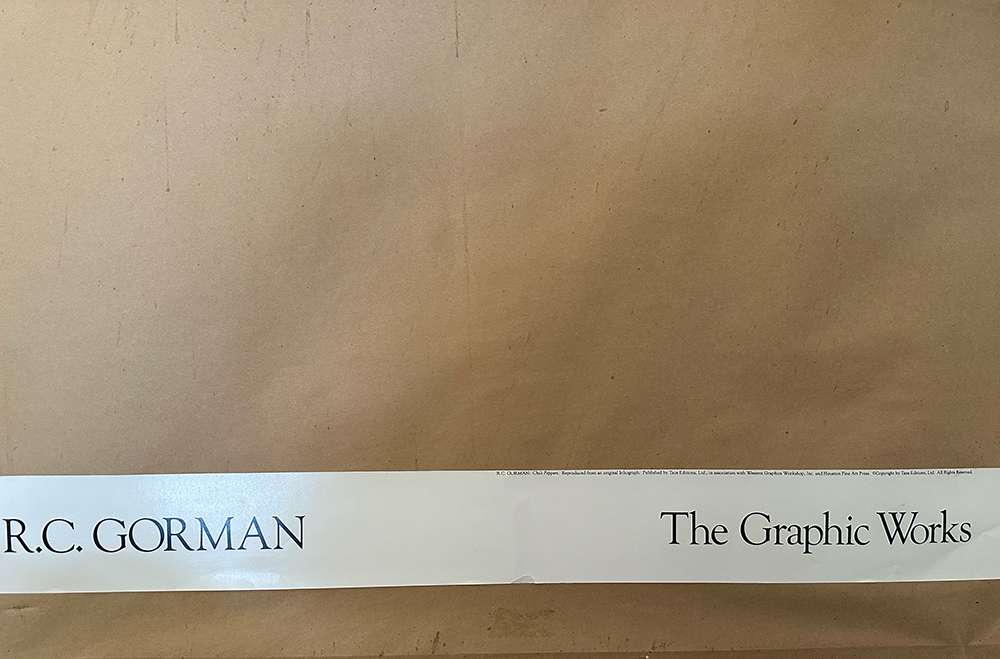
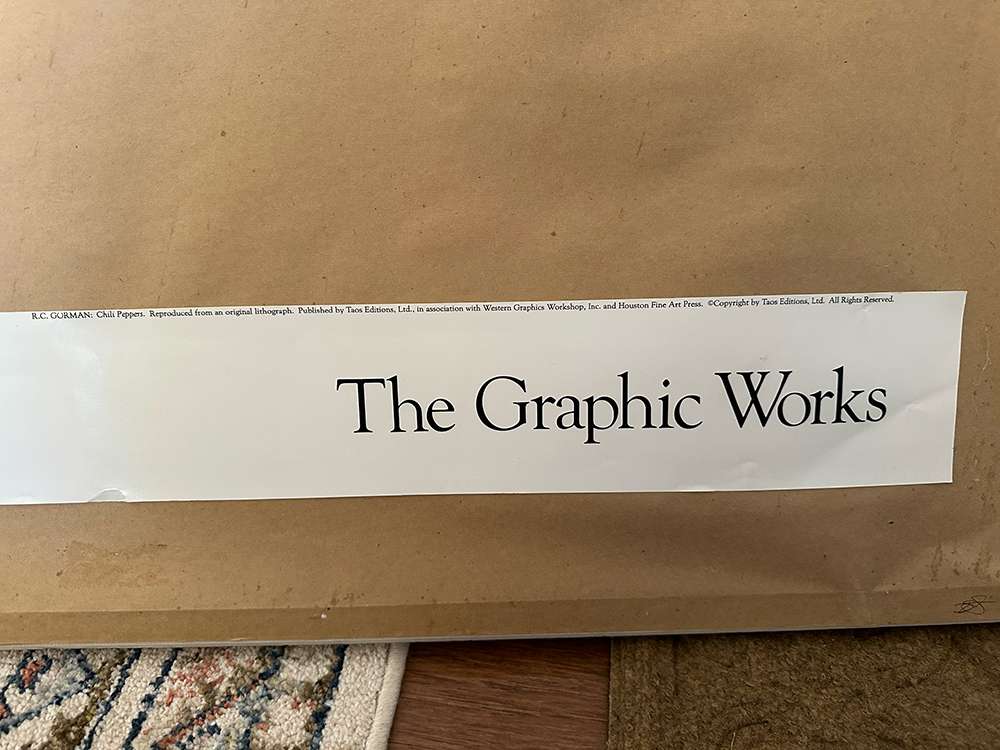
As we were looking through the discounted items, we noticed the large letters on the back of the framed art—R.C. Gorman. It was a large matted print in a pretty nice frame. It was so large it did not fit on the table with the rest of the discounted items and was sitting on the ground leaned up against the table. Both of us stopped pretty immediately and I quickly pulled the framed print off the ground and started checking it out.
At the time we did not know much about the art. We were familiar with R.C. Gorman because my grandmother was a collector, but as far as this specific piece, we did not know much. But, the art was originally priced at 30 dollars and was marked down to 6 dollars, so we pretty much immediately knew we would make the purchase. It was a good deal and we love supporting this shop, so that is how we came into our R.C. Gorman print, which we found out was titled, “Chili Peppers.”
About R.C. Gorman’s “Chili Peppers”
Once we got the piece of art home with us we were able to inspect it closer. Obviously we found out the art was titled, “Chili Peppers.” Furthermore we also noticed it was signed in the lower right hand corner and of course, we had some information on the back, where we originally noticed R.C. Gorman’s name.
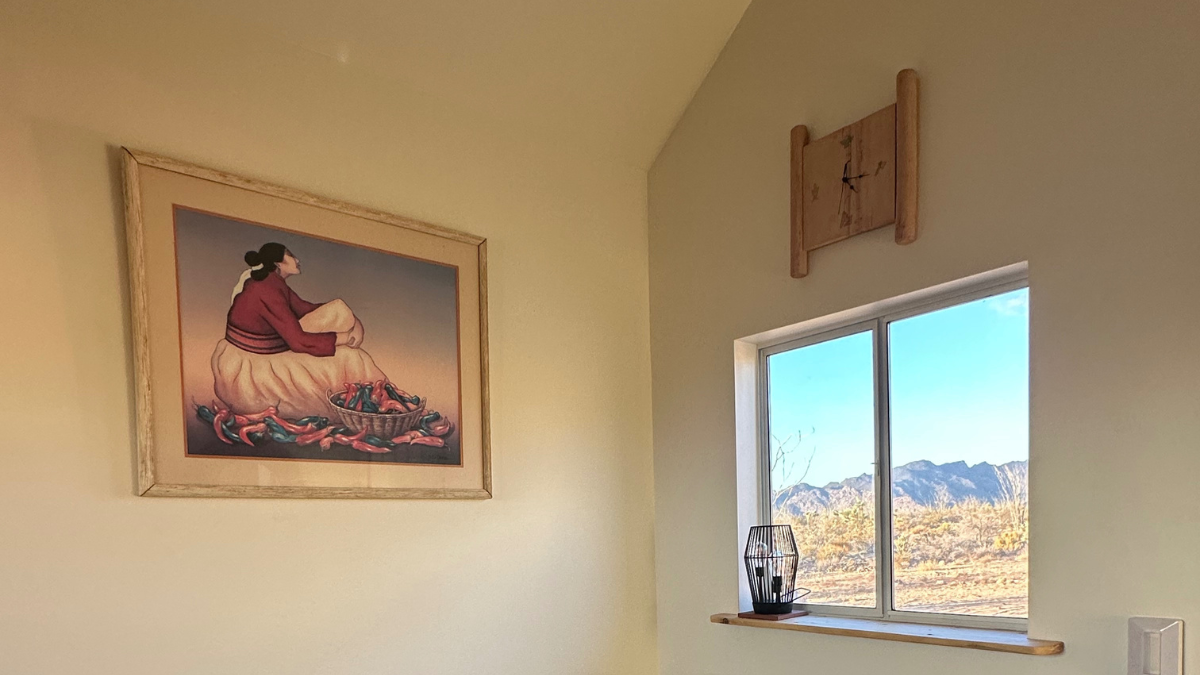
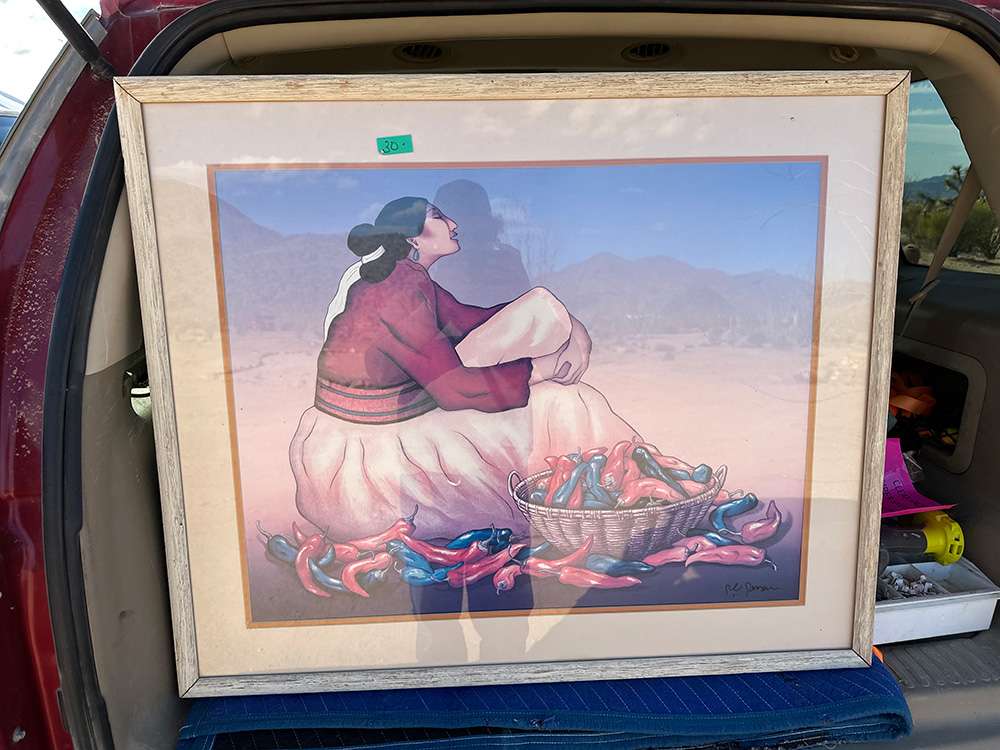
Chili Peppers is a piece Gorman first produced in 1987. It has one of Gorman’s famous Native American women sitting on the ground grasping one of her own legs. Red and Green Chili peppers surround her on the ground and a basket full of the same chili peppers sits near her on the ground.
The piece is simple yet elegant. The colors are warm and comfortable and overall the piece is nice to look at, we really enjoy it hanging in our office.
About R.C. Gorman
The following list includes a few bits of information about R.C. Gorman from around the internet. Some of these notes come from artist biographies on different websites and other quotes come from more general internet sources, but overall these points paint a good picture of the life of R.C. Gorman. I hope you enjoy!
- “I was born near Canyon de Chelly in Chinle, Arizona July 26, 1931. I spent my early years living close to nature and Navajo tradition. My family was rich in artistic talent and creative spirit, but not in material possessions. I have been fortunate to live and work in the beautiful Taos Valley, of New Mexico, an environment also rich in artistry and tradition. The spirit of Taos has encouraged and inspired me, and my focus as an artist matured here. I’m truly grateful to my friends, drinking buddies, family, patrons, and my loyal staff—all of whom have made my way of life here possible. Thanks for sharing the light.” – R.C. Gorman Bio in 1998 Navajo Gallery
- “R. C. Gorman grew up in a traditional Navajo hogan, and began drawing at age 3. His grandmother helped raise him, recounting Navajo legends and enumerating his genealogy of artist ancestors.” R.C. Gorman – Wikipedia
- “In World War II, Gorman’s father served as one of the Navajo Code Talkers who used their Indigenous language to encode US military communications. Gorman followed in his father’s footsteps and served in the US Navy. Before and after his military service, Gorman studied literature and art in Flagstaff, Arizona, Mexico City (where he was significantly influenced by Mexican muralists Diego Rivera and David Alfaro Siqueiros), and San Francisco, California where he lived 1955-1968.” – Roswell Museum, RC Gorman: Depicting Strong Women
- “In 1968, Gorman opened the Navajo Gallery showcasing 55 artists. It was the first indigenous-owned fine art gallery in the United States.” – National Museum of the American Indian, R.C. Gorman Collection
- “San Francisco played a crucial role in Gorman’s life as the origin of his artistic success and the development of his queer identity. In San Francisco, Gorman helped organize the American Indian Arts Group, serving on the painting committee as chairman. It was also during his time in San Francisco when an associate outed him as gay to his parents. After the unsanctioned disclosure, Gorman wrote in a letter to his parents, “I am a homosexual. It’s unfortunate only in that I myself did not tell you.”” – Roswell Museum, RC Gorman: Depicting Strong Women
- “He moved away from more European depictions and began painting strong Navajo women, in honor of those who raised him.” – National Museum of the American Indian, R.C. Gorman Collection
- “In the 2019 article So Let Me Paint: Navajo Artist R.C. Gorman and the Artistic, Native, and Queer Subcultures of San Francisco, California in the Pacific Historical Review, Jordan Biro Walters elucidates the connection between Gorman’s subject matter and his queer identity by writing: ‘Gorman, in his private correspondence, often referred to himself as a woman… Gorman moved fluidly between genders in his performativity. He also reinterpreted traditional pieces of Navajo attire such as Navajo boots and jewelry as ‘drag.’ When he pondered wearing them outside of the Navajo reservation, they took on new meaning as a hybrid expression of both indigeneity and queer identity… Throughout his career, interviewers almost always asked Gorman why he painted women. The answer to this question is more complex when his own queer identity is taken into account. In a letter to gallery owner [John] Manchester, Gorman explained why: ‘It’s me. I am every… woman I draw.'” – Roswell Museum, RC Gorman: Depicting Strong Women
- “He was referred to as ‘the Picasso of American Indian artists’ by The New York Times, and his paintings are primarily of Native American women and characterized by fluid forms and vibrant colors, though he also worked in sculpture, ceramics, and stone lithography.” R.C. Gorman – Wikipedia
- Gorman was such an influential figure in the community that the governor of New Mexico ordered flags flown at half mast when they died. Executive Order 2005-053 Order that all flags be flown at half-staff in honor of R.C. Gorman. – November 03, 2005
Final Thoughts on Finding R.C. Gorman Art at the Thrift Store
I originally recognized the R.C. Gorman piece because I recall Gorman’s work in my grandmother’s house when I was growing up, so it was meaningful to find an original print of his art for my own enjoyment.
For those that may be interested in the value of our thrift find, we paid between 4-6 USD for our piece (we purchased other items as well), and Gorman’s Chili Peppers prints sells for between 600 and 1000 online. So, we came away with a really great deal, but the part of the find we will always find important is the memory and nostalgia. We will display the art proudly knowing what an influential figure the artist has been.
R.C. Gorman seems to have been an influential member of the Native American community, being one of the first to truly bring Native American art to the mainstream art culture in America. Gorman, also seems to have been a strong member of the LGTBQ community, and a supporter of women in society. For all of these reasons we are proud to have a piece of Gorman history hanging in our office.