
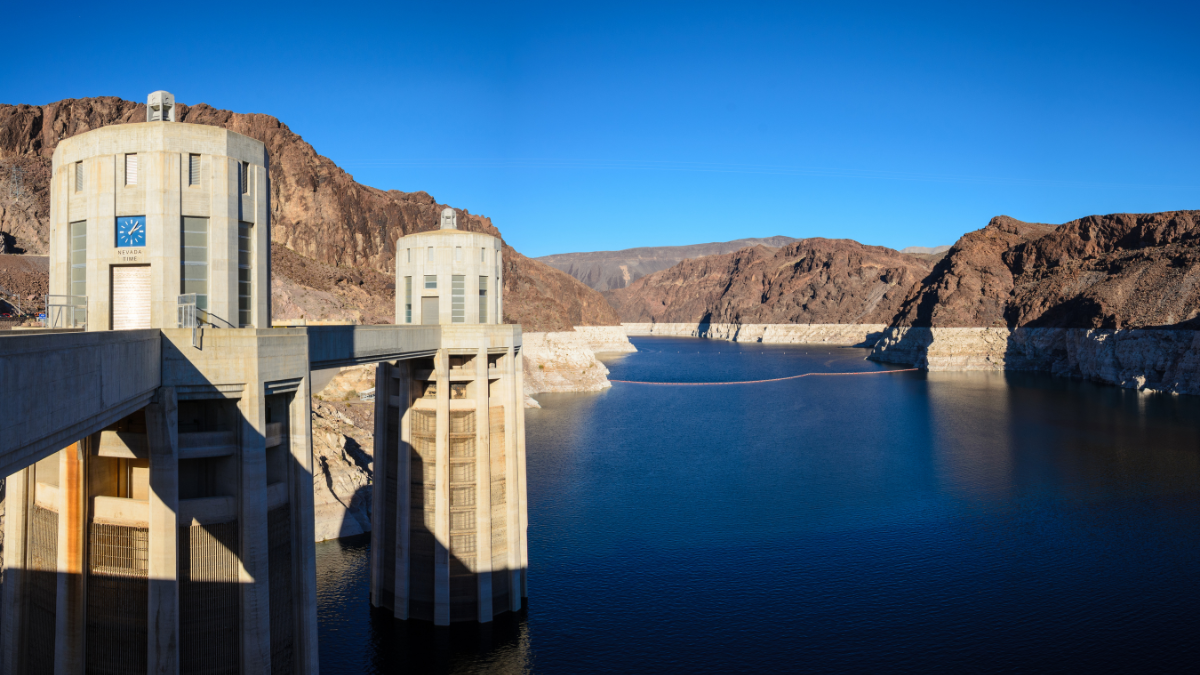
Lake Mead is one of the most recognizable landmarks in the American Southwest. Stretching across the Nevada–Arizona border, it is the largest reservoir in the United States and a critical source of water for millions of people. Each year, visitors arrive to boat, fish, and camp along its shores, often unaware that the reservoir covers more than water infrastructure alone. Beneath the surface lie traces of both a single settler town and much older Indigenous landscapes that were submerged to make the lake possible.
While Lake Mead is sometimes described as covering multiple “lost towns,” only one established American town—St. Thomas, Nevada—was permanently inundated by the rising waters of the reservoir following the construction of Hoover Dam. In addition to St. Thomas, however, the creation of Lake Mead also flooded numerous Indigenous Pueblo sites, including ancestral villages, dwellings, and cultural features that predated European settlement by centuries. Together, these submerged places tell a layered story about development, displacement, and whose histories remain visible.
Life Along the Colorado River Before the Dam
Before the dam, the Colorado River Valley supported many forms of human settlement. For Euro-American settlers, St. Thomas functioned as a small agricultural town where families farmed, raised livestock, and relied on the river for irrigation and daily life. Though modest in size, the town had homes, roads, a school, and a cemetery—features that gave residents a sense of permanence.
Long before St. Thomas existed, Indigenous peoples had lived along the river for generations. Puebloan communities built homes, farmed, traveled, and developed complex social and spiritual relationships with the land and water. These sites were not “towns” in the modern sense, but they were enduring places of habitation and cultural significance. The river shaped both settler and Indigenous lives, though in very different historical contexts.
The Hoover Dam and the Creation of Lake Mead
The construction of Hoover Dam marked a turning point for the region. Built during the Great Depression, Hoover Dam was one of the most ambitious infrastructure projects in American history. Designed to control flooding, generate hydroelectric power, and supply water to the rapidly growing Southwest, the dam represented one of the most ambitious infrastructure projects in U.S. history.
As Lake Mead filled in the 1930s, St. Thomas fell directly within the flood zone. Residents received notice and gradually abandoned the town. Homes were dismantled or left behind, and the cemetery was relocated where possible. The process unfolded slowly but definitively. By the early 1940s, St. Thomas had disappeared beneath the rising reservoir.
At the same time, the flooding also submerged numerous Indigenous archaeological sites throughout the valley. Many Pueblo ruins, dwellings, and cultural landscapes were covered without the same level of documentation or public attention. While the loss of St. Thomas became part of regional memory, the flooding of Indigenous sites often remained marginal in popular narratives about Lake Mead’s creation.
What Lies Beneath the Water
Under Lake Mead rest different kinds of remains. The foundations of St. Thomas—roads, building remnants, and irrigation features—represent a relatively recent chapter in the region’s history. The submerged Pueblo sites reflect a much deeper timeline, one that stretches back centuries before modern infrastructure reshaped the river.
Unlike open-air ghost towns, these places were hidden entirely beneath water. Over time, wooden structures deteriorated, and stone features settled into the reservoir floor. Their invisibility contributed to the idea that the land had been empty before development, reinforcing a narrative that overlooks long-standing human presence.
When Lake Mead’s Water Levels Drop
Ongoing drought across the Colorado River Basin has lowered Lake Mead to levels not seen since its early decades. As the water recedes, parts of St. Thomas have reemerged, including foundations and roadways that now sit exposed in the desert sun. These remains have drawn significant public attention, serving as tangible reminders of the town that once occupied the valley.
Some Indigenous sites have also become more vulnerable as water levels fluctuate, though many remain submerged or protected from public access. Exploration of these areas is discouraged to preserve both safety and cultural heritage. Still, their partial reappearance underscores that Lake Mead is not only a reservoir—it is a landscape layered with history.
Remembering the Communities Beneath Lake Mead
The creation of Lake Mead brought undeniable benefits: water security, electricity, and the foundation for growth across the Southwest. At the same time, it displaced people and submerged places that mattered deeply to those who lived there. St. Thomas represents one form of loss—a small settler town sacrificed to national infrastructure priorities. The flooded Pueblo sites represent another, tied to much older patterns of displacement and erasure.
Museums, historians, and Indigenous communities continue to document and protect what remains of these histories. Remembering them requires acknowledging both timelines and resisting the urge to simplify the past into a single story of progress.
A Landscape with Many Histories
Lake Mead is often framed as a triumph of engineering, but it is also a reminder that landscapes hold multiple histories at once. Beneath the water lies the story of St. Thomas, the only town fully lost to the reservoir, and the far older stories of Indigenous communities whose presence shaped the region long before modern dams existed.
The Mojave Desert is frequently described as empty, yet Lake Mead reveals how densely lived and deeply layered this place has always been. When water levels fall and traces briefly reappear, they challenge us to see the land not as blank space, but as a record of human lives—some remembered, others still fighting for recognition.
More Mojave Desert Content from Applied Worldwide
Discovering the Mojave Desert: A Complete Guide
Spring Brings Vibrant Cactus Flowers to the Mojave Desert


